CLUI exhibition: THROUGH THE GRAPEVINE: Streams of Transit in Southern California's Great Pass

New exhibit at the Center for Land Use Interpretation's Los Angeles location:


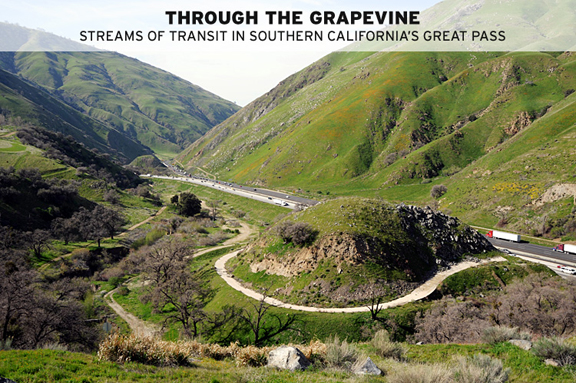
THROUGH THE GRAPEVINE: Streams of Transit in Southern California's Great Pass
Exhibit open from April 23, 2010

The mountainous passage that separates the great population of Southern California from the rest of the state is a zone of transit, from one epic region to another. Located at the collision of the San Gabriel and Tehachapi Mountain Ranges, this steep and convoluted terrain lies between the northern edge of the Los Angeles megalopolis and the depopulated place known as Grapevine, at the southern end of the Central Valley. Layers of traffic, water, and energy move like a braided stream through the mountainous terrain, connecting here to there.

grapevine.jpg

This exhibit is made possible by a grant from the Department of Cultural Affairs, City of Los Angeles and the CLUI Remarkable Roadways Program.

dca_logo.jpg

----

The Center for Land Use Interpretation
9331 Venice Blvd.
Culver City, CA 90232
310.839.5722 office
310.839.6678 fax
clui@clui.org
www.clui.org

Exhibit is open 12 - 5 PM, Friday, Saturday, and Sunday, or by appointment.
Admission is free.

Directions

A High Desert Test Sites Lecture & Workshop Series: The New Everyday Life


A High Desert Test Sites Lecture & Workshop Series


HDTS Headquarters
6470 Veterans Way
Joshua Tree, CA 92252

ANNOUNCEMENT

Join us for our premier pilot weekend of The New Everyday Life, a lecture and workshop series that will commence Saturday May 1st-Sunday May 2nd 2010.

In keeping with the HDTS mission to create truly alternative spaces for art that challenges traditional conventions of ownership, presentation and patronage, The New Everyday Life will bring together guest artists and participants whose talent and knowledge varies widely but who all share a desire to approach daily life with a blend of both experimental and practical thinking. For our weekend-long symposium that includes four workshops and an open-air dinner, we will enroll twelve students in an immersive suite of 2 hour classes held in special locations in and around the Morongo Basin.

The New Everyday Live is an endeavor designed to both stimulate conversation and catalyze action by considering overlap between contemporary art and craft, sustainable living, survival skills, ecology and earth science, and cultural variation. Each participant in The New Everyday Life will leave with a new set of skills and inspirations, after intimately experiencing the Mojave desert’s unique context for life and living.

ITINERARY

Saturday May 1st

12:00. Meet for introduction and driving maps at the HDTS Headquarters in sunny downtown Joshua Tree.

12:30 – 2:30 Visit Wells Pollock in his school bus leather working studio encampment on the edge of the marine base and learn how to do bootleg leatherworking using readily available household tools and implements.

3:30 – 5:30 Hang out with Trinie Dalton at A-Z West Cabin and practice bookmaking stitches to make a book about your experience of the desert. (Note: Dalton will contact participants in advance about prep, supplies, and other details to maximize stitch-learning time. Beginners to advanced bookmakers welcome.)

6:30 – 9:30 Travel to section six with Chantale Doyle to learn more about how she lived for one year in her vegi-oil powered VW Vanagon while supporting herself by selling on ebay.

Dinner. Chantale will fix everyone an exotic fish taco dinner on her van's cookstove.

Sunday May 2nd

12:00 – 2:00: Meet on the patio of A-Z West for a beer-making workshop with Katie Grinnan and a goodbye toast with her special honey basil, peach, and ginger brews.

PRESENTER BIOGRAPHIES

Chantale Doyle is an artist who lives in the Mojave desert near Joshua Tree. In 2007 Doyle spent a year living and traveling in a Volkswagen van powered by waste vegetable oil, which she learned to collect from dumpsters and filter to use as fuel for her vehicle. While traveling through twenty-four states and three provinces, Doyle created an exhibition of drawings that was shown in Japan, Canada and California in 2009. Doyle is now at work on a book about her experiences and continuing her efforts to live in a manner that nurtures creative independence. She owns Mt. Fuji General Store, next door to the HDTS headquarters.

For more info: http://web.mac.com/chandoyle/Site/Events/Entries/2009/10/18_Chantale_Doyle.html

http://www.chantaledoyle.com/


Wells Pollock was born on a Minnesota commune. Before moving to Joshua Tree to start a goat farm, he lived in New York City, the Mississippi River Valley, Spain, Holland and San Francisco, organizing experimental film screenings and music events. As a performance artist he once threw a year-long conceptual art and psychic orgy in Iowa City. He’s done everything from renovating a 16th century goat shack in southern Spain to cooking on a squatted boat in Amsterdam. He learned leatherworking at an S&M factory in San Francisco. Of this he says, “Leatherworking is one of humankind's most basic crafts. Unfortunately, most of it now doesn't match up with anybody's visions. My goal is to help people realize their dreams of belts, collars, wristbands and so much more. I like making things that are beautiful, functional and that my friends can still afford! Most of the leather I use is salvaged and I am working on designing my own hardware.” Pollock lives in a renovated school bus on the Copper Mountain Mesa.

Trinie Dalton has authored, curated, and/or co-edited five books: Wide Eyed (Akashic), A Unicorn Is Born (Abrams), Dear New Girl or Whatever Your Name Is (McSweeney's), Mythtym (Picturebox) and Sweet Tomb (Madras Press). Her books vary between pure text and experiments with art + image. She teaches bookarts at NYU and Pratt, and exhibits or builds lectures around her handmade books’ subject matter. Her most recent event/exhibitions were at Deitch Projects in New York for Gelatin’s PIG Sunday School series, and at Las Cienegas Projects in Los Angeles. Her next book will be published by Ecstatic Peace Library.

For more info: http://sweettomb.com/

Katie Grinnan is an internationally exhibiting artist from Los Angeles. Her work focuses on using imagery and physicality to exploit the alchemical nature of perception and space. Her interest in making beer began by happenstance, stopping into a beer making shop and realizing that beer is a sort of homespun alchemical process. It's everyday magic. Her beer is called Wizard Brew.


LOGISITICS

Cost:

The cost is $120 per person for the weekend that includes Chantale's fish taco dinner. All proceeds are used to cover basic event expenses and to pay the speakers.

Enrollment:

Due to the intimate nature of this event the group will be limited to twelve people. No application is needed, but spaces will be filled on a first come first serve basis. If you would like to enroll please email info.hdts@gmail.com – you will be emailed instructions so that you can pay via Paypal, the first 12 people who pay will be signed up for the course.

Lodging:

A limited amount of campsites are available on Zittel’s property, and can be pre-arranged with the host on a first come, first serve basis. Alternately, camping in Joshua Tree National Park or staying in a local hotel are excellent options. For lodging recommendations please visit the HDTS website’s Directions page.

For future updates and event listings for future incarnations of The New Everyday Life email us at info.hdts@gmail.com

EXPERIENTIAL GEOGRAPHY 101

New Works: Experiential Geography 101

EXPERIENTIAL GEOGRAPHY 101 is a journey deep inside KARL CRONIN's idiosyncratic research, presented with footnotes and nerdy flare. A mash-up of performance, natural history lecture, and cognitive science experiment, this is dance masquerading as a graduate seminar. Through movement, spoken word, and film, the beauty of our natural world is revealed one layer at a time.

http://experientialgeography.com/

KARL CRONIN is a NYC-based movement artist who is creating and performing a Somatic Natural History Archive of the USA. Each day he spends time with a different plant or animal species, and then brings his experiences back to the studio where he creates a movement sketch. New archive entries are presented in a weekly, free performance offering. This work is a direct result of creative research support provided by the Interdisciplinary Laboratory for Art Nature and Dance (iLAND- NYC), Movement Research (NYC), and the Santa Fe Art Institute (NM).

MEREDITH JAMES AT Marc Jancou Contemporary

MEREDITH JAMES
ESPALIER
APRIL 17-MAY 22, 2010
OPENING RECEPTION: SATURDAY, APRIL 17TH, 6-8 PM


ennouncement Featured Image
See-Through, detail


Marc Jancou Contemporary is pleased to announce Meredith James' first solo show in New York, Espalier.

Meredith James' videos and sculptures engage architectural space and sequential narrative through a series of inversions and perceptual events. Shot in an abandoned subway station, Six uses simple in-camera techniques to recast the spatial and temporal coordinates of the experience of a passing train. Not unlike early experiments in film, James' work tends to lay bare its mechanism, preferring to acknowledge the perceptual shifts even as they occur. Carefully structured time lags are distributed between moments of recognition within the narrative structure of a video or the spatial arrangement of sculptural elements.

James' use of unconventional viewing apparatuses compounds the experience; videos are rear-projected inside homemade TVs and sculptures sit behind walls. See-Through is a tubular knot constructed of found windows, which are fit together, and then built into a temporary wall. As in her videos, James reveals the structure of the piece by creating alternate vantage points and entries into the work. The diorama titled "A stand of roadside cholla against which small birds had been driven by the storm and there impaled" may be seen either through a tiny peephole or through the prism of windows in See-Through.

Born in 1982, James lives and works in New York. She received her MFA from Yale University, and her BA from Harvard University. Recent group exhibitions include Symbol Rush, Newman Popiashvili, New York; Experiment, Institute of Contemporary Art, Boston; Kings County Biennial (curated by Kidd Yellin and James Fuentes), Kid Yellin, New York; People Weekly (curated by Linda Norden), The Graduate Center, CUNY, New York; Careerists and Visionaries (curated by Jacques Louis Vidal), Marc Jancou Contemporary, New York; and Labyrinthitis, Rivington Arms, New York.

For more information please contact Kelly Woods at kelly@marcjancou.com.


Marc Jancou Contemporary
NEW ADDRESS
524 WEST 24TH STREET
New York, New York 10011
T 212 473 2100 F 212 473 2222
WWW.MARCJANCOU.COM
info@marcjancou.com

INTERNATIONAL CONFERENCE ON THE CONSTRUCTED ENVIRONMENT


INTERNATIONAL CONFERENCE ON THE CONSTRUCTED ENVIRONMENT
Venice, Italy
17-19 November 2010
http://www.ConstructedEnvironment.com/conference-2010/

This year's conference will be held in Venice, Italy alongside the 12th International Architecture Exhibition of the Venice Biennale. The Constructed Environment Conference is a place to explore the forms and functions of the constructed environment during a time of dramatic and at times disruptive change. The conference is a cross-disciplinary forum that brings together researchers, teachers and practitioners to discuss the past character and future shape of the built environment. The resulting conversations weave between the theoretical and the empirical, research and application, market pragmatics and social idealism. In professional and disciplinary terms, the conference traverses a broad sweep to construct a transdisciplinary dialogue which encompasses the perspectives and practices of: architecture, anthropology, business, design, economics, education, engineering, environmental design, industrial design, interior design, landscape architecture, sociology, town and regional planning, and transportation.

As well as an international line-up of plenary speakers, the conference will also include numerous paper, workshop and colloquium presentations by practitioners, teachers and researchers. Participants are invited to submit a presentation proposal for a 30-minute paper, 60-minute workshop, or a jointly presented 90-minute colloquium session.

Presenters may choose to submit written papers for publication in the refereed International Journal of the Constructed Environment. If you are unable to attend the conference in person, virtual registrations are also available which allow you to submit a paper for refereeing and possible publication, as well as access to the journal. We also encourage you to present on the conference YouTube Channel. Please select the online sessions link on the conference website for further details.

The deadline for the next round in the call for papers (a title and short abstract) is 13 May 2010. Future deadlines will be announced on the conference website after this date. Proposals are reviewed within two weeks of submission. Full details of the conference, including an online proposal submission form, may be found on the conference website at http://www.ConstructedEnvironment.com/conference-2010/ .

Contact:
Prof. Jeffery S. Poss
School of Architecture
University of Illinois at Urbana-Champaign, USA
For the Advisory Board, International Conference on the Constructed Environment and The International Journal of the Constructed Environment

RESIDENCY APPLICATION: PLAND, Practice Liberating Art through Necessary Dislocation

Be a Resident at PLAND!

Residency Overview and Application Form


APPLICATIONS DUE: MAY 10 at pland.info@gmail.com

***************

PLAND, Practice Liberating Art through Necessary Dislocation, is an off-the-grid residency program that supports the development of experimental and research-based projects in the context of the Taos mesa. PLAND finds its inspiration in a legacy of pioneers, entrepreneurs, homesteaders, artists, and other counterculturalists who – through both radical and mundane activities – reclaim and reframe a land-based notion of the American Dream. While producing open-ended experimental projects that facilitate collaboration and hyper-local engagement, PLAND is a constantly evolving, art-informed rural outpost in the New Mexican high desert. Through project-based residencies and work parties, residents are encouraged to marry survival-based goals with big ideas and experimental methods. Without expectations about prescribed outcomes, PLAND privileges process over product. We believe that people that can do amazing things when supported and encouraged in new contexts and there is no context like that of the Taos mesa. Part alternative school, part laboratory, part homestead, part art studio, PLAND is an active solution for merging art into life.

Download the RESIDENCY APPLICATION FORM:
Word
or pdf

Who may apply:
If you are a worker, maker, thinker, or doer who brings self-awareness, experimental processes and creativity to what you do – and PLAND sparks some ideas for you – then you are eligible to apply for a residency.

What it means:
PLAND is a burgeoning program – an idea associated with a specific location and new forms of production. We believe that a place is made by living in it and we want you to help us make PLAND by being here, by living it. Through an active reinvestment in daily life and by collaborating with amazing people, we aim to not only cultivate PLAND but also to test new ways of being in the world. That said, we invite you to propose a project that will involve some level of collaboration with us and with the place. While we don’t expect you to be familiar with the Taos mesa in detail before you arrive, the most successful project will be site-responsive in that it considers localized geography, history, culture, language, architectural traditions or otherwise. We are interested in proposals that might problem-solve our water situation or result in a garden, but we’re equally as interested in pairing you with our neighbor Bob (who has woven homes out of willows) or facilitating a collaboration with the local community center. For us, building community is as important as building shelter.

Prior to your arrival, we’ll have on-going conversations about your residency at PLAND. We’ll let you know when we score some second-hand windows, how we managed to buy the chain saw, who we met that reminded us of you… you’ll basically become part of it all so that when you arrive you’re ready, you’re here, you’re home.

What to expect:
PLAND has only just begun! In 2009 we purchased 1.25 acres of high desert at a land auction. The land is raw – no electricity or water and the road is rough but short. Situated approximately 40 miles northwest of Taos, PLAND is a rural outpost on the edge of the ever-nearing grid. As we draft this call for proposals, the land sits under a new covering of snow and until the ground thaws and we’ve relocated our lives to the mesa, the building has yet to begin. Never fear! By the time you arrive, we’ll have an outhouse, a way to cook and clean, and some form of shelter in which to sleep. Be aware that this is not the residency during which you will make paintings or write novels. We do not have studio spaces nor is this residency about working in isolation. Although humble, rugged, and not without its plentiful share of hardship, we offer you the opportunity to get in touch with the basics. Water, shelter, fire, weather, dinner, blue, people, time and space – all of these elements become the daily luxuries in which you’re invited to indulge.

We provide:
- a compelling context
- localized access to neighbors, materials, possibilities
- loads of local secrets like where to get a shower, where to find wild asparagus, how to battle the heat
- opportunities to collaborate with locals and with us
- outings into town for laundry, cuisine, nightlife, internet, etc.
- outings into the wilds for foraging, hot springs, recreation, etc.
- (wo)man power! We will help produce and build your project. Yes, that means we’re working side-by-side, day-by-day
- a growing library of manuals, almanacs, maps, novels and children’s books
- the tools we have on hand
- the materials we’re able to gather
- shelter
- water
- first-aid kit
- collaboratively cooked dinners
- conversation
- presentation of your work on our website
- a trickle of fascinated and fascinating visitors, all willing to help out
- transportation to Texas for a report to our funders, the Idea Fund
- contextualization and amplification of your project to a broad audience
- modest stipend for materials, travel, tequila, whatever

You provide:
- transportation to Taos
- food
- basic survival stuff (canteen, flashlight, work shoes, etc.)
- ideas and inspiration
- a good attitude
- flexibility regarding your proposal – everything might change once you arrive!
- a continuous 2-4 week commitment to being at PLAND
- means of documenting your work
- a waiver stating that you come to PLAND at your own risk

Application process:
First let us state that although we can only choose one resident, we hope to receive a lot of proposals so as to assess the broad appeal of PLAND. Based on your proposals, we’ll know who is interested in this place and why and, henceforth, how to plan our future around a set of collective interests.

By May 10:
1)
Email completed application form, with additional pages and supporting materials as necessary, to pland.info@gmail.com

2) Send $15 application fee/gesture of support:

via PayPal:
click on the “Donate” button at the top right-hand side of this webpage

OR

via postal mail: please note that this is a P.O. Box, so please do not send large packages
Nina Elder/PLAND
423 State Road 150
El Prado, NM
87529

By May 31:
We will contact you to let you know if you should start packing.

Why an application fee?
Part of the experiment of PLAND is about resource sharing. While we could make excuses about administration costs, we prefer to think of the application fee as a statement of support. Your fees will go directly into building PLAND, both physically and conceptually and will signal that you believe in what we’re doing. We’ll put your money towards something we really need – like firewood or a cistern or a generator or a chain saw – and we’ll list you as a supporter on our website.

Another part of the PLAND agenda is to forge alternative and hybrid economies, so know that we’re open to some non-monetary methods of support. If you prefer an alternative, simply choose something that you think we’ll need, or check our website Wish List, and send it to our physical mailing address. Be sure to specify your method of contribution in the email application form.

Got questions? We’re sure you do! Just ask ‘em at pland.info@gmail.com

Writing Marathon at the University of New Mexico Art Museum

UNM | Art Museum
Man Ray, Noire et blanche, 1926 ©2010 Man Ray Trust / Artists Rights Society (ARS), New York / ADAGP, Paris

But what exactly is a Writing Marathon?

A Writing Marathon is a long period of time of sustained writing in an environment that is a resource of ideas and a source of inspiration. Place matters and writing marathons respect this.

Writing Marathons offer the opportunity to take risks and share them with others, to be in new spaces and witness the influence it has on your work, and to listen to other's pieces. There are no rules, no pressure, and lots of encouragement from like-minded souls.


Writing Marathon at the Museum
Man Ray, African Art and the Modernist Lens
Sponsored by the High Desert Writing Project, in partnership with the UNM Art Museum

This writing marathon will involve viewing the exhibit, brief discussions about the art, and opportunities to write and share. Participants need not be accomplished writers, but are expected to have an interest in writing.
Who: Writers 15 - 99+ years of age

Where: University of New Mexico Art Museum (in the Center for the Arts)

When: April 10, 2010 from 1:00 - 4:00 PM

Bring: Something to write on and pencils (NOTE: NO PENS are permitted in the Art Museum)

Cost: $10
Registration:
To register for this event, please email Chuck Jurich at


The Art Museum is handicapped accessible - please make prior arrangements with Sara Otto-Diniz at sodiniz@unm.edu.

For more information on the Man Ray exhibition please visit http://unm.edu/~artmuse

For more information on High Desert Writing Project please visit http://hdwp.org

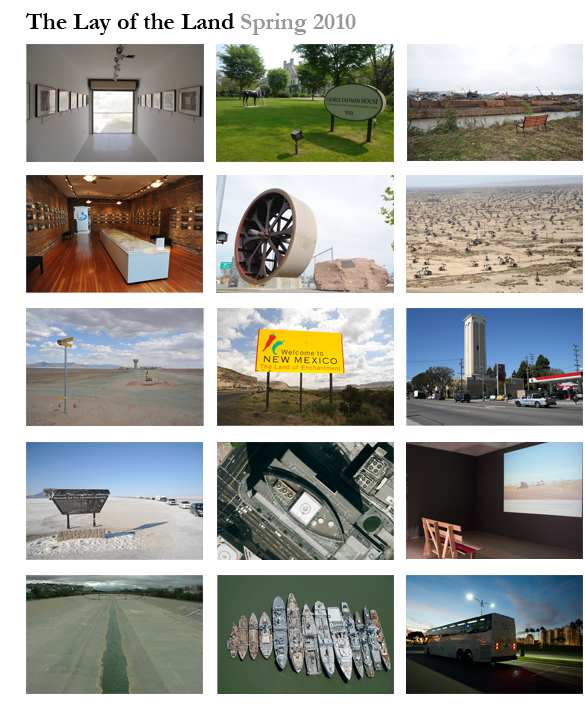
SPRING ISSUE OF LAY OF THE LAND

The Spring 2010 edition of the Center for Land Use Interpretation's The Lay of the Land newsletter is now available on the Center's newly redesigned website!

Click here to receive a print copy of the Lay of the Land newsletter.

lotl-grid2010.jpg

----

The Center for Land Use Interpretation
9331 Venice Blvd.
Culver City, CA 90232
310.839.5722 office
310.839.6678 fax
clui@clui.org
www.clui.org

DONALD JUDD CONFERENCE


Save the Date

“Donald Judd: Delegated Fabrication”
Conference and Exhibition, Portland, Ore.

Sunday, April 25, 2010
University of Oregon in Portland
White Stag Block

From the outside a Donald Judd piece is seamless, hiding all traces of it’s construction. But behind the final piece is a rich history of the artist’s intent and his method for fabrication. Join us for a groundbreaking discussion of Judd’s art, lead by contemporary art scholars and Judd’s longtime fabricator. The day-long conference in Portland, Ore, will look at Judd as an icon of the American minimalist movement, as well as issues of authenticity and fabrication that continue to have lasting implications for artists today. In addition, the conference will explore the artist’s connection to Pacific Northwest, where he created a site-specific piece in 1974 for the Portland Center for Visual Arts (PCVA).

A related exhibition will be presented in the University of Oregon’s White Box visual laboratory.

Conference Speakers:
Robert Storr -- Dean of the Yale School of Art and past curator at the Museum of Modern Art, art critic and painter
Peter Ballentine —Judd’s longtime fabricator, curator and artist
Bruce Guenther — Curator of modern and contemporary art at the Portland Art Museum

Conference organized by Peter Ballantine and Arcy Douglass

Registration (includes boxed lunch):
$65 early registration by March 22; $85 after
$35 for students

To register, visit www.juddconference.com

Conference blog at www.juddconference.posterous.com


ART AND TECHNOSCIENCE: CONFERENCE IN HELSINKI FINLAND

ART AND TECHNOSCIENCE
Practices in transformation

A conference by the Academy of Fine Arts in Helsinki Finland, in
collaboration with the Finnish Bioart Society and Pixelache festival.

Time: 24-25.3.2010 10-17h
Location: Auditorium, Academy of Fine Arts in Helsinki, Kaikukatu 4.
Accessible for everyone and free entry

Detailed schedule and more information:
www.kuva.fi www.kilpiscope.net www.pixelache.fi

Keynotes by Roy Ascott and Jill Scott

The beginning of the 21st century is characterized by an overwhelming
awareness of environmental issues. Facing the threat of global
warming, the findings of scientific research have become a subject of
intensive political debate. The ethical questions traditionally
discussed in the green-wing marginals have become mainstream, as
science has become a coffee-table topic.

The field of art that interacts with the practices of science and its
technologies is commonly referred to as ART&SCIENCE. During the past
decades, this hybrid field has become more or less established, with
landmark works, major institutions and written histories. However,
with the new wave of environmentalism, a further wave of artists
working with methods and questions related to scientific research has
also emerged.

The conference seeks to contextualize the practices of ART&SCIENCE
both in the contemporary political atmosphere and the history of
contemporary art.

The first day of the two-day conference focuses on the practices in
transformation as a result of research-orientation and
cross-disciplinarity, characteristic to the field of ART&SCIENCE.

The second day of the conference looks at the technologies of
encounter between human and non-human worlds. The aim is to address
the ethical discourse taking place in art practices which look at the
interaction between humans and non-humans.

Speakers include:
Pau Alsina (researcher, ESP)
Roy Ascott (artist, theorist, UK)
Laura Beloff (artist, researcher, FI)
Erich Berger (artist, coordinator ArsBioarctica, AUT/FI)
Andy Gracie (artist, UK/ESP)
Terike Haapoja (artist, FI)
Eija Juurola (forest researcher, FI)
Jan Kaila (artist, professor, FI)
Tuija Kokkonen (theatre director, FI)
Minna LÄngström (artist, lecturer, FI
Anu Osva (artist, FI)
Ingeborg Reichle (art historian, DE)
Antti Sajantila (professor, medical doctor, FI)
Jill Scott (artist, researcher, AUS/CH)
Helena Sederholm (professor, FI)
Raitis Smits (artist, curator, LV)
Ulla Taipale (curator, FI/ESP)
Manu Tamminen (microbiologist, FI)
Adam Zaretsky (artist, US)

Contact
Erich Berger
Coordinator ArsBioarctica
eb@randomseed.org
http://kilpiscope.net

Terike Haapoja
Artist, Phd researcher
mail@terikehaapoja.net
http://kuva.fi

THE SECRET KNOWS: LOS ANGELES NOMADIC DIVISION


LAND INVITES YOU TO JOIN US FOR A SPECIAL INSTALLATION

THE SECRET KNOWS

MARCH 17-21, 3PM-3AM
THE VIRGIN MOBILE FREEHOUSE, 508 8TH STREET, AUSTIN, TEXAS

THIS EXHIBITION SPONSORED BY VIRGIN MOBILE IN COLLABORATION WITH C3 PRESENTS, IN ASSOCIATION WITH LG

KINDLY RSVP TO RSVP@NOMADICDIVISION.ORG

TRIPLE CANOPY #8

Triple Canopy, Issue 8

Online now:
Triple Canopy, Issue 8
Hue and Cry


Support Triple Canopy and its contributors
If you value the work we’ve been doing and would like to enable us to do more of it—and publish with greater frequency—please consider making a tax-deductible donation online now.


Currently online:

De Tribus Impostoribus
by Victoria Miguel
An Internet play inspired by the eponymous book (which was neither written nor published), consisting of three dialogues on the limits and imperfections of language.

Inside the Mundaneum
by Molly Springfield
Snail-mail Google and a card-catalog Web: a fin-de-siĂšcle Belgian information scientist’s proto-Internet.

Thirty-Six Shades of Prussian Blue
by Joshua Cohen
“Turnbull’s Blue—Antwerp Blue—Berlin Blue—Prussiate of Iron—Chinese Blue—Saxon Blue—Blau de Berlin—Pariser-blau”: reading the world’s first artificial color.

Podcast:

Bangkok Is Ringing, Episode 1
by Ben Tausig
A series exploring the politics of urban sound in Bangkok and beyond, through first-person reporting, field recordings, and analysis. In this debut episode, Tausig takes listeners from a storefront Pentecostal church in Brownsville, Brooklyn, to the noisy streets of Thailand’s capital.

Coming soon:

Everglade
by Lucy Ives
“A story in which I explain”: a collage and prose poem.

R, Adieu
by Joe Milutis
The primal violence and utopian trill of the rolled r, the most rrresilient of locutions.

Sacrifice of the Banana
by Karthik Pandian
An ecstatic bestiary. A prequel to 2012. Shot by the temple police. Performed for the video camera. A film.

Horse People
by Ben Yaster
Among the silvery breeders, sunburned frat boys, and other endangered species of Baltimore’s Preakness Stakes.

The Road to Unification Village
by Sukjong Hong
A letter from the Demilitarized Zone, where South Korea is imagining its way out of perpetual war.

Crude Meridian
by Sophia Al Maria with Manal Al Dowayan
The story of the cowboy oilmen who branded the Gulf: “The desert of Arabia is America's last frontier.”

The Sea of Trees
by Joshua Zucker-Pluda & Nine Eglantine Yamamoto-Masson with Jacob Kirkegaard
Mapping the Japanese forest where the spirits of suicides linger, silence reigns, and compasses fail.

And more podcasts—readings, sound art, interviews, reports, radio serials—from Ed Park, Dan Torop, and others.


Triple Canopy works collectively with writers, artists, researchers and other collaborators on projects that deal critically with culture and politics, and the ways people engage them, both online and in the world at large. These investigations are realized in an online magazine as well as in public programs and print publications encompassing various fields and locales. We aim to present work and advance ideas informed by a multitude of disciplines and perspectives, and to disseminate them among a broad and diverse audience. Triple Canopy, a nonprofit 501(c)3 organization, was founded in late 2007; our first issue was published on March 17, 2008.

Subscribe | Support | | |

Triple Canopy

Place:Appalachia: Summer Course At West Virginia University


A new two-week field course, Place:Appalachia, is being offered this summer by Erika Osborne at West Virginia University.

For more information visit: http://artanddesign.wvu.edu/placeappalachia


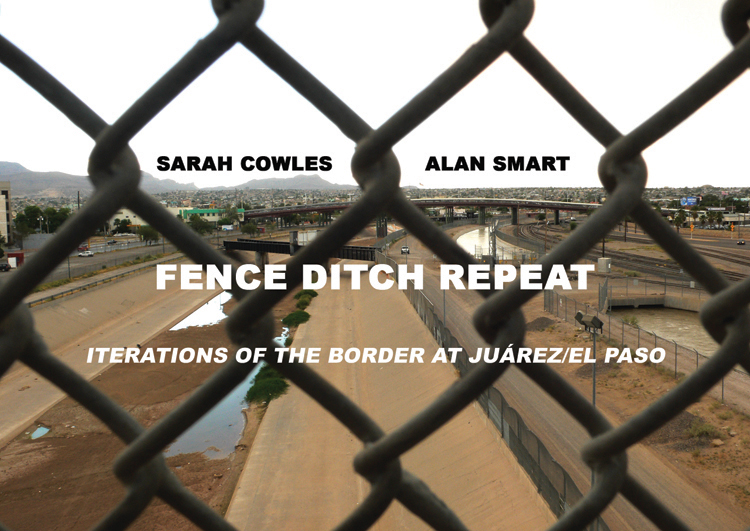
FENCE DITCH REPEAT: New exhibit and public presentation at the Center for Land Use Interpretation's Los Angeles

cowles.jpg

FENCE DITCH REPEAT: Iterations of the Border at JuĂĄrez/El Paso
Exhibit opens on Friday March 5, 2010

A CLUI Independent Interpreter exhibit featuring the work of Sarah Cowles and Alan Smart.

Sound by John Also Bennett.
Independent Interpreter event - Sarah Cowles will talk about the exhibit Fence Ditch Repeat on Saturday, March 13 at 7:30pm. (Please arrive early, seating is limited.)

This Center for Land Use Interpretation Independent Interpreter program is made possible by the support of the Andy Warhol Foundation for the Visual Arts.

----

The Center for Land Use Interpretation
9331 Venice Blvd.
Culver City, CA 90232
310.839.5722 office
310.839.6678 fax
clui@clui.org
www.clui.org


Exhibit is open 12 - 5 PM, Friday, Saturday, and Sunday, or by appointment.
Admission is free.

3rd annual NMU Indigenous Earth Issues Summit

Taking Action for Mother Earth:
The upcoming 3rd annual NMU Indigenous Earth Issues Summit

By Aimée Cree Dunn

This year’s Indigenous Earth Issues Summit, to be held on April 5 in the NMU Great Lakes Rooms, promises to be another exciting event. Indigenous activists from Turtle Island’s East and West and many places in between will gather to offer their skills and knowledge on how to effect change for Mother Earth.

The third annual Summit will focus on taking action. As part of this, Summit participants will have the opportunity to learn such skills as how tribes can take action against polluting industries by exercising their sovereign right to regulate air and water quality on and around reservations. Lee Sprague of the Little River Band will conduct a workshop on the topic.

Participants in the Summit will also have the chance to learn from long-time Native activist and lawyer, Gail Small, of the Northern Cheyenne. Small, Ms. Magazine's 1995 Gloria Steinem Women of Vision Award winner, has been fighting coal mining for over 25 years. She will offer her experience in “using organizing, alliances, legal challenges, and the drafting of tribal laws to assert tribal control over resource extraction on and around Indian reservations” to those who attend her workshop.

Our Indigenous brothers from the East Coast have also been invited to join us. Bettina Washington and Chuckie Green of the Mashpee Wampanoag Nation will present on their tribe’s opposition to the mega-windfarm proposed for Cape Cod. The Mashpee Wampanoag’s opposition is based on protection of sacred sites as the proposed mega-windfarm would interfere with traditional ceremonies.

Other workshop presenters include Ben Yahola (Quasartte/Tokobutchee), Co-director of Mvskoke Food Sovereignty Intitiative of Oklahoma, will teach about the Native spiritual connections between food and Mother Earth. Damien Lee, Anishinabe (Ojibwa) from Fort William First Nation, will give a workshop offering his firsthand experience in organizing effective “community decolonization by addressing environmental racism affecting traditional territories.”

The event will wrap up with a keynote address from American Indian Movement activist, scholar, and author, Ward Churchill. In his presentation, “Water is Life: Reflections on an Omnicidal Equation,” he will offer a holistic perspective on Indigenous environmental issues and will discuss how Indigenous concerns over water issues fit into the context of this bigger picture. "[C]olonialism equals genocide," he writes in his book Struggle for the Land. He adds that "colonialism also equals ecocide." The Native "struggle for the liberation of our homelands" is "a struggle to achieve decolonization." This is not only a Native issue in Churchill’s eyes. “Like it or not, we are all – Indian and non-Indian alike – finally in the same boat,” he points out. “Either Native North America will be liberated, or liberation will be foreclosed for everyone, once and for all.” According to Churchill, “We must take our stand together.”

And that is exactly what the Summit is all about – taking action together to protect Mother Earth from the excesses of industrialization. The third annual Indigenous Earth Issues Summit is about sharing wisdom and expertise and about uniting to learn, engage and go forth armed with skills and knowledge to effect positive change for Mother Earth.

The Summit is free and open to all. No registration is required.

For more information, including a call for eco-vendors and a draft Summit schedule, please visit www.nmu.edu/nativeamericans. Questions can also be answered by calling 906-227-1397.

The Summit is sponsored by the NMU Center for Native American Studies with the generous support of the Keweenaw Bay Indian Community and the NMU Ethnic and Cultural Diversity Committee.

reNEWable Times Square: Designing Temporary Surface Treatments

reNEWable Times Square: Designing Temporary Surface Treatments

The Mayor’s Fund to Advance New York City invites eligible artists, designers, organizations, and non-profits living or operating within the City to propose temporary design solutions to renew the surface treatments at all five plazas and smaller ancillary spaces located on Broadway from 47th to 42nd streets. These temporary surface treatments will enhance the plazas while a long-term capital reconstruction project is initiated for the Bowtie beginning in 2012 in partnership with the Department of Design and Construction.

The final selected design shall be translated into a surface treatment by a contractor selected by the New York City Department of Transportation. The selected artist shall be awarded a design fee in the amount of $15,000 to be funded by the Mayor’s Fund.

The design is expected to be installed by mid-July. The temporary treatment will remain in place for approximately eight months and will be monitored and maintained by the Times Square Alliance. The deadline to submit proposals is Friday, April 16, 2010. Questions and answers will be posted to this website. Details on how to submit questions are contained in the RFP.

To learn more:

http://www.nyc.gov/html/dot/html/about/broadway.shtml

2009 Land Heritage Institute Art-Science Symposium


Bonneville Speedway, east of Wendover, Utah, September 14, 2009, image Land Arts of the American West

A review of the 2009 Land Heritage Institute Art-Science Symposium appears in the Spring 2010 Art Lies contemporary art quarterly.
To read, visit: http://www.artlies.org/article.php?id=1869&issue=65&s=0


Jarrod Beck: Capture at Second Floor in Marfa

Jarrod Beck: Capture
March 6 - May 31, 2010


NY-based artist J. Beck follows his installation at the Lawndale Art Center in Houston with a two-part exhibition at Second Floor in Marfa, Texas. The initial phase of the installation commences next week (March 2 - 6) and will be created on-site in real-time. A variety of works on paper will provide a glimpse of the exterior complement, to be completed between April 9 - 16. Built forms and structural pieces reminiscent of Beck's previous works will be extended from the stairwell and sides of our beloved silver box. Viewers are welcome to swing by Second Floor throughout these periods to witness Jarrod's creative process firsthand. We'll be hosting two separate receptions to communicate Capture - March 6 and April 16.

Please Join us Saturday, March 6 to view Part I of Capture (6pm-8pm, beverages provided)

Jarrod will be interviewed on Marfa Public Radio's "Talk at Ten" on Wednesday, March 3, at 10am (listen online at marfapublicradio.org)

learn more:
secondfloormarfa.com/home.html


LAND ARTS 2010 ADMISSIONS: TEXAS TECH

LAND ARTS 2010 ADMISSIONS

Opening The Cultivated Wilderness, or, What is Landscape? architecture critic Paul Shepheard reveals that “This book is about seeing things that are too big to see.” He goes on to provide three clear frames to orient our recognition: “The Wilderness of the book’s title is the world before humans appeared in it, and the Cultivation is everything we’ve done to it since. Landscape is another name for the strategies that have governed what we’ve done.” Investigating earthworks or land art is a way of mapping the intersection of geomorphology and human construction. Earthworks begin with the shape of the land and extend through the complex social and ecological processes that create landscape. Including the full array of human activity marking the planet, from petroglyphs to roads, dwellings, monuments and traces of those actions, earthworks show us who we are.

Since 2001 Land Arts of the American West has been developing as an interdisciplinary field program expanding the definition of land art and our relationship to landscape. Land Arts is a semester abroad in our own back yard. Connecting the pedagogic potential of travel with the rigors of field research.

Land Arts at Texas Tech University seeks to cultivate collective energy within an expanded interdisciplinary range of examinations from architecture, the built environment, public culture, literature, science, and geography to explorations of contemporary art practices. Note that in 2010, thanks to the generosity of the James Family Foundation, there will be support for at least one participant to attend from outside Texas Tech University.

The College of Architecture is recruiting students from across Texas Tech University and beyond for Land Arts 2010.

Information Meeting: Tuesday, March 9, 2010, 5:00pm, Architecture and Art Courtyard

This meeting is for all students interested in applying to the program. We will review the program overview and application details.


Application Deadline: Tuesday, March 30, 2010, 5:00pm, Architecture Bldg. Rm: 709

Notification of Acceptance: Tuesday, April 13, 2010


Visit http://landarts.org/index.php/site/cat/admissions/ to download the application materials.

For additional information about Land Arts of the American West visit http://landarts.org and http://arch.ttu.edu/wiki/Land_Arts_of_the_American_West. The exhibition of work by Land Arts 2009 is on view in Lubbock at the new LHUCA Warehouses until March 7, 2010. Additional information about the exhibition, including documentation, can be found at http://landarts.org/index.php/site/events/cat/exhibitions/.

For questions and additional information please contact Chris Taylor at chris.taylor@ttu.edu.

CALL FOR ARTISTS: Center for Art +Environment (CA+E) Announces Launch of the First A | W | E Grant

In 2010, the Nevada Museum of Art’s internationally recognized Center for Art +Environment (CA+E) announces the launch of a grant program for visual artists and writers working together in the field: The Artists | Writers | Environments: A Grant Program (A | W | E)

Funding for the program is provided by The Andy Warhol Foundation for the Visual Arts.

The program is designed to:

· encourage the creation of new art + environment projects addressing environmental challenges rather than simply comment on them

· to foster deeper and more immediate public awareness of art + environment projects

· to encourage unique field reports of lasting value to scholars and other artists.

Teams of visual artists and writers working on art + environment projects anywhere in the world from July 2010 through August 2011 will be eligible to apply for the first A | W | E Grant. Letters of interest must be received via e-mail on or before Friday, April 16, 2010 with invited applications due on or before June 22, 2010. The grant recipients will be announced on or before July 6, 2010.

During this first year, one grant of $10,000 will be awarded to a team of artist(s) and writer(s) - of particular interest will be those proposals addressing communities stressed by global change. Publication venues by writers can include articles in magazines, journals, or online, and chapters or essays in books, but significant public outreach will be favored.

The Nevada Museum of Art

Nevada’s only art museum was founded in Reno in 1931 and is a general art museum with a strong and longstanding focus on Art + Environment.

Visit the Center for Art + Environment at the Nevada Museum of Art website for more information at www.NevadaArt.org/ae/center