|
| ||
| The City of Albuquerque Open Space | ||
| The Open Space Visitor Center will host a collection of land based installations by the following artists in the gallery and in the Bosque adjoining the facility. The Opening Reception for these events will be Sunday, June 21 from 1-4pm in conjunction with the performance Sixty Water Weaving Women at La Orilla Canal at 2:30pm. Read more here. | ||


OPEN SPACE at LAND/ART


Lay of the Land: Spring 2009 Issue

CLUI photo of the bus tour to Pyramid Lake as part of the Art + Environment Conference last October.
The latest issue of the Lay of the Land is out, check it out online.
World Science Festival: New York

Science and the Arts at CUNY Graduate Center just sent out an update about the World Science Festival underway in New York. The full schedule can be found here.
Katie Holten's Tree Museum

TREE MUSEUM at the Grand Concourse
"Katie Holten created the TREE MUSEUM to celebrate the communities and ecosystems along the Grand Concourse, a 100 year-old boulevard in The Bronx. Visitors will be able to listen in on local stories and the intimate lives of trees offered by current and former residents: from beekeepers to rappers, historians to gardeners, school kids to politicians." -from Katie Holten's site
Read the review in the Times
inadvertent memorial: the entropic state of the Enola Gay Hangar, Wendover, UT
 Enola Gay Hangar, June 2009, photo by Elizabeth Ellsworth
smudge just completed a three day visit to the CLUI's Wendover Complex in Wendover UT. We inhabited SIMPARCH's off-the-grid, sustainable life support building on the historic Wendover airfield--a renovated and completely re-imagined WWII vintage Quonset hut called "clean livin'".
Part of our work there and on the rest of our 32 day research trip now underway, is to look for inspiration for a project on "infrastructure as civic pedagogy."

Wikipedia defines infrastructure as
the basic physical and organisational structures needed for the operation of a society or enterprise, or the services and facilities necessary for an economy to function. . . . In military parlance, the term refers to the buildings and permanent installations necessary for the support, redeployment, and operation of military forces.
As part of our current research trip, we're exploring how "land use interpretation" might offer new ways to understand infrastructure as a “social covenant” (William Morrish). Infrastructure--such as the Enola Gay hangar, the Wendover Airbase, the museum being developed on the base--can be read to reveal social dynamics and values. A close look at what gets built in the name of infrastucture can suggest the meanings and functions of systems intended to create and support communities.
If we frame infrastructure through the lens of land use interpretation, we can decipher "lessons" in public responsibility that are implied by infrastructure priorities, design and development.
Today, the Enola Gay hangar exists as a piece of obsolete, decaying infrastructure. In its current state of near collapse, it is a signal of the continuing--maybe even deepening--complexities of the realities that surround atomic weapons in general and America's role in being the first and only country to unleash them in particular.
But it now seems that the hangar will be transformed from infrastructural relic to memorial infrastructure.
The Historic Wendover Airfield recently received $450,000 in public funds from the Federal Government's "Save America’s Treasures" program. The money will be used to re-roof the metal hangar portion of the building, re-roof the north and south operations offices and shops, and provide siding and windows for the building.
We realized that this visit to the airbase might be our last chance to experience and creatively respond to the hangar's striking state of dematerialization after nearly 50 years of exposure to extreme elemental forces.
After two days of visits, we discovered that the Enola Gay Hangar exists today as accidental memorial architecture.
It inadvertently echoes some of the most celebrated formal elements used by architects whose work memorializes traumatic historic events: interplay of light and shadows, tortured and twisted superstructures, dark corridors that lead to blinding light, access to views of the sky, labryrinth-like passages, physical traces of human presence and absence, metaphoric allusions to historical sites and events.
 Berlin Holocaust Memorial, photo by Josh Tidsbury
  U.S. Holocaust Memorial Museum, photo by MusicRob
 Jewish Museum in Berlin-Kreuzberg, photo by Sebastian Niedlich (Grabthar)
Enola Gay Hangar, June 2009, photo by Elizabeth Ellsworth

Enola Gay Hangar, June 2009, photo by Elizabeth Ellsworth
 Enola Gay Hangar, June 2009, photo by Elizabeth Ellsworth
 Enola Gay Hangar, June 2009, photo by Elizabeth Ellsworth
Other memorials have preserved civic and military infrastructure--not as restorations--but as the ruins that they became as the results of traumatic WWII events. Enola Gay Hangar, June 2009, photo by Elizabeth Ellsworth
 Enola Gay Hangar, June 2009, photo by Elizabeth Ellsworth
The Genbaku Dome, Hiroshima Peace Memorial, photo by MC MasterChef

USS Arizona Memorial, Pearl Harbor, photo by Tammy Green
We started to imagine a preserved Enola Gay hangar--not as it was in 1945, nor even as it is today. But transformed into a place that could allow its complex history, meanings, and emotional associations to be felt, remembered, and recognized . . . while at the same time inviting its visitors to activate it, as infrastructure, and as "civic pedagogy," in new ways.
SIMPARCH's transformed Quonset hut--both "preserved" as a piece of Wendover Airfield's history AND re-invented as infrastructure to house and inspire artists in the midst of a still-active military airbase--stands ready to serve as inspiration.
 Clean Livin' by SIMPARCH, photo by Elizabeth Ellsworth

Clean Livin', photo by Jamie Kruse
We started to imagine a preserved Enola Gay hangar--not as it was in 1945, nor even as it is today. But transformed into a place that could allow its complex history, meanings, and emotional associations to be felt, remembered, and recognized . . . while at the same time inviting its visitors to activate it, as infrastructure, and as "civic pedagogy," in new ways.
SIMPARCH's transformed Quonset hut--both "preserved" as a piece of Wendover Airfield's history AND re-invented as infrastructure to house and inspire artists in the midst of a still-active military airbase--stands ready to serve as inspiration.
 Clean Livin' by SIMPARCH, photo by Elizabeth Ellsworth
Clean Livin', photo by Jamie Kruse

Into the Sunset

 smudge is about to head west for a month of research travels--to archives, CLUI sites in Wendover, UT and Los Angeles, the LAND/ART events in New Mexico, nuclear landscapes across the Southwest, and generally to search for direct experiences of geologic time.
A couple weeks back, we blogged about going to see MOMA's "Into the Sunset" exhibition. We found that it created an inspiring mindset for anticipating our travels West.
The exhibition's photographs span the nineteenth to the twenty-first centuries and feature work of seventy photographers, including Robert Adams, John Baldessari, Dorothea Lange, Timothy O'Sullivan, Cindy Sherman, Joel Sternfeld, Edward Weston, Richard Misrach and Carleton E. Watkins.
MOMA describes the exhibition as "incorporating a range of artistic strategies, motifs, and concerns." But we were struck by what seemed to remain constant across nearly all of the sites, moments, events, and styles. Namely, monumental, unchanging land forms across which unfold all manner of human acts of "passing through."
As pictured in this exhibition, the idea of the America West takes form in direct relation to movement. The vernacular of the Hollywood western expresses that idea: "I'm just passing through, mame." "They went thataway." "Which way to ...?" "Where was he headed?" "It's time I moved on." And apparently, the idea of the American West as a site of passing through remains contemporary: "The federal Office of Navajo-Hopi Indian Relocation is winding down what has become one of the largest relocation efforts in U.S. history (2008)."
In image after image, decade after decade, the backgrounds of the exhibition's photographs are composed of vast expanses of seemingly unchanging scapes, those of the mountain, desert, urban plain, highway, and trail. While in the foregrounds, each landscape witnesses its own unique moment of traversal by humans, via horses, trains, cars, military vehicles, earth movers, portable dwellings of 19th century Native Americans, expanding suburban tracts, mattresses on floors, Hollywood sets.
Passing through seems to reach its limit at the edge of the continent. Yet even there, the urban, suburban, and exurban landscapes of California continue to appear in these photographs as places of "moving through." Either literally--as when tectonic plates and mudslides tear driveways away from garages, or metaphorically--as when those who "dwell" here appear to be coiled and about to spring.
Ken Johnson, in a review of the exhibition for the New York Times, calls it a "bleak view of America’s realization of its Manifest Destiny." He wonders out loud why the exhibition projects such a dim vision of both "pathetic" people and commercial and environmental degradation of the land. He wonders out loud:
As we're about to head into the sunset ourselves, we suspect that an "unknown" alternative--one worth exploring--is indeed being generated. A number of people are right now responding creatively to the "American West" through a variety of land art works, acts of land use interpretation, and collaborations with scientists. Their projects involve photography as well a variety of other media and actions--including contemporary subjects and modes of response not depicted in the MoMA exhibition.
- "Is it impossible for serious contemporary photography to see something better?
- Is failure and disappointment the real, unavoidable story?
- Or is it another myth, a paradoxically reassuring narrative to which many high-minded people now unthinkingly accede?
- If so, what would be the alternative? That could be an unknown worth exploring."
Aspects of the American West not visualized in the exhibition include the nuclear west, waste (landfill, nuclear and otherwise), mines and quarries (as altered landscapes), industrial infrastructure, dams--all subjects handled by many artists working in response to the American West today. Not handled, however, with senses of "failure" or "disappointment." Instead of further idealizing or further de-mythologizing the West, as those included in the exhibition often do (did), a number of artists traversing the American West today turn a deadpan gaze toward the material realities and physical experiences they encounter. While the resulting works often present the West as monumental and mesmerizing, they are grounded in realities that are far from mythical--realities that each of us could set out for, into the sunset, and find for ourselves.
Here & There: Seeing New Ground: Opening Exhibition of LAND/ART
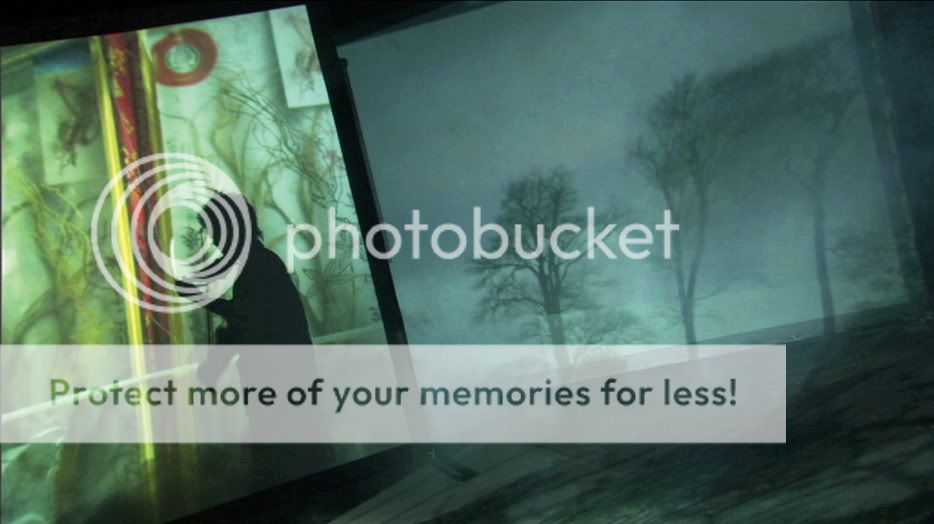 Laurie Anderson
Hidden Inside Mountains
2005, video still
516 ARTS announces Here & There: Seeing New Ground, the first exhibition for LAND/ART, opening Friday, June 5, 5-8pm. LAND/ART is a large-scale collaboration organized by 516 ARTS, exploring land-based and environmental art, involving over 25 organizations during 6 months in Albuquerque, Santa Fe and Mountainair. Here & There: Seeing New Ground features contemporary artists examining the landscape from perspectives that are both visual and cultural, including explorations of Native American film, as well as Native and non-Native artists who subvert landscape perspective to examine issues of the environment and human beings’ relationship with nature. Through photography, painting, drawing, sculpture, print, film and installation, these artists offer interpretations of the land and landscape both within and without human interaction. The exhibition is curated by 516 ARTS with experimental film artist Marcella Ernest and Nancy Marie Mithlo, Assistant Professor of Art History and American Indian Studies, University of Wisconsin-Madison. The exhibition catalog features an essay by Nancy Marie Mithlo inspired by the film Intrepid Shadows by Alfred Clah (1966), on view throughout the exhibition. Learn more on the LAND/ART website.
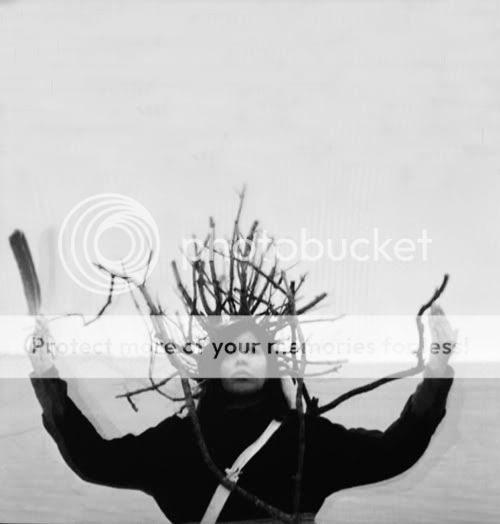 Shelley Niro
Tree
2006, film still
Zach Meisner at Open Space (LAND/ART)
 image of PAINTED JETTY JACKS by Zach Meisner at Open Space as part of LAND/ART
Located in the south-east side of the River Loop Trail in the Bosque, Meisner will use organic milk-based paints that are environmentally safe (VOC free) and designed to bio-degrade to re-color the existing Jetty Jacks, altering the appearance of their presence in the Bosque and the viewer's perception of the Jacks in this environment.
For more information contact:
Joshua Willis
Open Space Coordinator
http://www.cabq.gov/openspace/
Land Arts of the American West book review in Santa Fe Reporter

Zane Fischer reviews Bill Gilbert's and Chris Taylor's new book, Land Arts of the American West, and the LAND/ART project in the Santa Fe Reporter ("Finally Landing, A new book and planned events bring land art to the level it deserves").
Green Platform

Art Ecology Sustainability
24 April – 19 July 2009
curated by Lorenzo Giusti and Valentina Gensini
at the Centro di Cultura Contemporanea Strozzina
Palazzo Strozzi, piazza Strozzi, Florence, Italy
Artists
Alterazioni Video, Amy Balkin, Andrea Caretto e Raffaella Spagna, Michele Dantini, Ettore Favini, Futurefarmers, Tue Greenfort, Henrik Håkansson, Katie Holten, Dave Hullfish Bailey, Christiane Löhr, Dacia Manto, Lucy + Jorge Orta, Julian Rosefeldt, Carlotta Ruggieri, Superflex, Nicola Toffolini, Nikola Uzunovski
curated by Lorenzo Giusti and Valentina Gensini
Green Platform examines, in an interdisciplinary fashion, the issue of the environment in the dual sense of a crisis in our thermo-industrial society based on non-renewable sources of energy and of an ecological crisis caused by pollution and by the worrying overheating of our planet. The problem of ecology is analyzed and understood in its myriad philosophical, psychological, environmental, economic and social implications. Green Platform defines ecology not merely as a natural science but as a science of interrelations, confines and cross-border osmosis, the focal link in the partnership between nature and culture.
The exhibition presents a series of works by international artists who, acting in the wake of the pioneer experience that developed in the avant-garde movements of the Sixties and Seventies, address the issues of the environment, ecology and sustainability.
Green Platform offers various kinds of active experience: workshops with artists and other players in the environmental associations and NGO's, a series of lectures with experts in various relevant disciplines and the screening of videos and documentaries on environment-related issues.
curated by Lorenzo Giusti and Valentina Gensini
Green Platform examines, in an interdisciplinary fashion, the issue of the environment in the dual sense of a crisis in our thermo-industrial society based on non-renewable sources of energy and of an ecological crisis caused by pollution and by the worrying overheating of our planet. The problem of ecology is analyzed and understood in its myriad philosophical, psychological, environmental, economic and social implications. Green Platform defines ecology not merely as a natural science but as a science of interrelations, confines and cross-border osmosis, the focal link in the partnership between nature and culture.
The exhibition presents a series of works by international artists who, acting in the wake of the pioneer experience that developed in the avant-garde movements of the Sixties and Seventies, address the issues of the environment, ecology and sustainability.
Green Platform offers various kinds of active experience: workshops with artists and other players in the environmental associations and NGO's, a series of lectures with experts in various relevant disciplines and the screening of videos and documentaries on environment-related issues.
Contemporary Tate - May 2009 - Richard Long
This from Chris Taylor and the Land Arts Listserv:
 click to view larger image
For details, see the Tate website.

 click to view larger image
 For details, see the Tate website.
JACKRABBIT HOMESTEAD
 Artist Kim Stringfellow has announced her new project JACKRABBIT HOMESTEAD.
The project, "is a forthcoming book and web-based multimedia presentation featuring a downloadable car audio tour exploring the cultural legacy of the Small Tract Act in Southern California's Morongo Basin region near Joshua Tree National Park. Stories from this underrepresented regional history are told through the voices of local residents, historians, and area artists—many of whom reside in reclaimed historic cabins and use the structures as inspiration for their creative work."
Check out and attend the May 22nd event at Farmlab

Cynthia Hooper Lecture @ Sea and Space Explorations

Hooper will also screen a 7 minute video entitled CESPT:
The two rivers that serve the city of Tijuana, Mexico—the inbound Colorado and the outbound Tijuana—are two heavily litigated, politically contentious, courageously border-defying bodies of water. Artificially yoked by a 118-mile long aqueduct that spans northern Baja’s vast desert, these two conjoined entities labor to hydrate this rapidly and perilously expanding metropolis. This video investigates one particular segment of this vast, transnational trajectory of water—from its storage at the city’s picturesque reservoir, to its transport, treatment, remediation, and ultimate release into the Pacific Ocean.We've embedded CESPT below for those of us who can't make the screening. You can also view it and several of Hooper's other works on Vimeo.
CESPT from Cynthia Hooper on Vimeo.
Maya Lin's Monumental Earthwork: Wavefield at Storm King Art Center

A monumental work of land art or "earth art", as New York Times reviewer Holland Cotter calls it, was unveiled this weekend at Storm King Art Center, just outside of New York City in Mountainville. Maya Lin's “Storm King Wavefield” is the third and last in her series of wavefields. It is also the largest: a 240,000 square feet earthwork taking up four acres, with heights of 15 feet.
Storm King says this about the work:
. . . the largest site-specific earthwork created to date by acclaimed artist and environmentalist Maya Lin. Occupying an eleven-acre site that was a gravel pit until Ms. Lin reclaimed it for the work, the ambitious Storm King Wavefield comprises seven rows—each over 300 feet long—of carefully scaled, undulating hills that give the appearance of ocean waves.
Artists + Environments web exhibition launch

Today smudge studio launched a web exhibition of its recently completed project entitled: Artists + Environments: Generative Practices and Conversations.
The project began with a three-week long web event in March, 2009. smudge studio orchestrated a collaboration among 16 artists, art educators, museum educators, and media designers whose works address natural, built, and virtual environments.
Collaborators used a blog to experiment with and creatively respond to five gestures (drawn from the Walker Art Center's "Elements and Principles of Today's Art') that shape contemporary art: hybridity, time, space, performance, and appropriation. Each week, moderators kicked off the conversation with provocations. Moderators included Bill L. Fox, Susan Rotilie, and Colin Robertson.
The project began with a three-week long web event in March, 2009. smudge studio orchestrated a collaboration among 16 artists, art educators, museum educators, and media designers whose works address natural, built, and virtual environments.
Collaborators used a blog to experiment with and creatively respond to five gestures (drawn from the Walker Art Center's "Elements and Principles of Today's Art') that shape contemporary art: hybridity, time, space, performance, and appropriation. Each week, moderators kicked off the conversation with provocations. Moderators included Bill L. Fox, Susan Rotilie, and Colin Robertson.
On March 26, 2009, we took the results to graduate students in Penn State’s School of Visual Arts “Web 2.0 Pedagogies” class, taught by Karen Keifer-Boyd. There, Karen and her students helped design the web exhibition during a charrette facilitated by smudge.
You can view the project's press release and description here.
You can experience the exhibition, along with documentation of the design charrette, on ExtremeMediaStudies.org (click on "web exhibitions" or "web exhibition: generative conversations"). You'll find video, interactive image and text "echoes," extracted themes, and contextualized text excerpts from the conversation's flow.
We invite you to creatively appropriate the web exhibition for your needs as artists, teachers, and museum educators. Please pass it along. Let us know what you think and how it's taken up.
We invite you to creatively appropriate the web exhibition for your needs as artists, teachers, and museum educators. Please pass it along. Let us know what you think and how it's taken up.
Photocartographies

On May 16, Photocartographies: Tattered Fragments of the Map opens at g727 in Los Angeles.
Photocartographies, organized by independent curators Adam Katz and Brian Rosa, is self-described as, "a curatorial project materializing in multiple forms: an exhibition, a publication and a series of public programs."
The map in this project is taken up, "not a representation so much as a system of propositions. This project reveals mapping itself as a generative process of knowledge creation, a liberatory method for re-imagining and re-imaging our world, its built and natural environments, and the relationship between space and place."
Check out the tatteredfragments.info website for more information about the exhibition, related events, artworks for sale, and book (including an essay by Bill Fox).
Photocartographies, organized by independent curators Adam Katz and Brian Rosa, is self-described as, "a curatorial project materializing in multiple forms: an exhibition, a publication and a series of public programs."
The map in this project is taken up, "not a representation so much as a system of propositions. This project reveals mapping itself as a generative process of knowledge creation, a liberatory method for re-imagining and re-imaging our world, its built and natural environments, and the relationship between space and place."
Check out the tatteredfragments.info website for more information about the exhibition, related events, artworks for sale, and book (including an essay by Bill Fox).
Land Arts Listserv: Remote Studio at the Artemis Institute

A donation for scholarships at the Artemis Institutes's Remote Studio was announced on the Listserv this week. Visit Artemis for more info about application guidelines and calls for projects.
The content of this post is reproduced from the Land Arts of the American West listserv with permission.
To join the list, visit the listserve webpage here.
Land Arts Listserv: Tacita Dean, JG Ballard and the Spiral Jetty
 Spiral Jetty, a 1970 earthworks sculpture of a 1,500 foot long spiral made of 6,650 tons of black basalt. Photograph: George Steinmetz/Corbis
Chris Taylor sent out a notice this week (on the Land Arts Listserv) of Tacita Dean's recent article marking the passing of JG Ballard. The piece reflects upon Dean and Ballard's shared interest in Robert Smithson's Spiral Jetty. The original article can be accessed in the Guardian.
The content of this post is reproduced from the Land Arts of the American West listserv with permission.
To join the list, visit the listserve webpage here.
Matters of Perspective: Freeman Dyson in the Times

On March 25th, the New York Times Magazine ran an extended story about physicist Freeman Dyson. The media outlet has taken note of the scientist's stance on a contemporary topic that looms large in relation to the emerging field of art + environment - global warming. Dr. Dyson has a unique take on the subject, and is no stranger to being controversially and influentially intertwined with issues affecting landscape and land use. Most people are familiar with two commonly reproduced, and rather mesmerizing, quotations of his that were spoken and written (several decades ago) in response to another force that greatly influences the contemporary landscapes of the United States - nuclear weapon development and testing. These quotes can be found in John McPhee's Basin and Range, Rebecca Solnit's Savage Dreams, and Trevor Paglen's recent Blank Spots on the Map.
From John Else's Day After Trinity:
"I have felt it myself. The glitter of nuclear weapons. It is irresistible if you come to them as a scientist. To feel it's there in your hands, to release this energy that fuels the stars, to let it do your bidding. To perform these miracles, to lift a million tons of rock into the sky. It is something that gives people an illusion of illimitable power, and it is, in some ways, responsible for all our troubles - this, what you might call technical arrogance, that overcomes people when they see what they can do with their minds."
From his own, Disturbing the Universe, in response to visiting Jackass Flat in 1959.
"It is a soul-shattering silence. You hold your breath and hear absolutely nothing. No rustling of leaves in the wind, no rumbling of distant traffic, no chatter of birds or insects or children. You are alone with God in that silence. There in that white, flat silence I began to feel a slight sense of shame for what we were proposing to do. Did we really intend to invade this silence with our trucks and bulldozers and after a few years leave it a radioactive junkyard?"
Comments posted in response to the Times article appear here.
"I have felt it myself. The glitter of nuclear weapons. It is irresistible if you come to them as a scientist. To feel it's there in your hands, to release this energy that fuels the stars, to let it do your bidding. To perform these miracles, to lift a million tons of rock into the sky. It is something that gives people an illusion of illimitable power, and it is, in some ways, responsible for all our troubles - this, what you might call technical arrogance, that overcomes people when they see what they can do with their minds."
From his own, Disturbing the Universe, in response to visiting Jackass Flat in 1959.
"It is a soul-shattering silence. You hold your breath and hear absolutely nothing. No rustling of leaves in the wind, no rumbling of distant traffic, no chatter of birds or insects or children. You are alone with God in that silence. There in that white, flat silence I began to feel a slight sense of shame for what we were proposing to do. Did we really intend to invade this silence with our trucks and bulldozers and after a few years leave it a radioactive junkyard?"
Comments posted in response to the Times article appear here.
Subscribe to:
Posts (Atom)


 Posts
Posts

